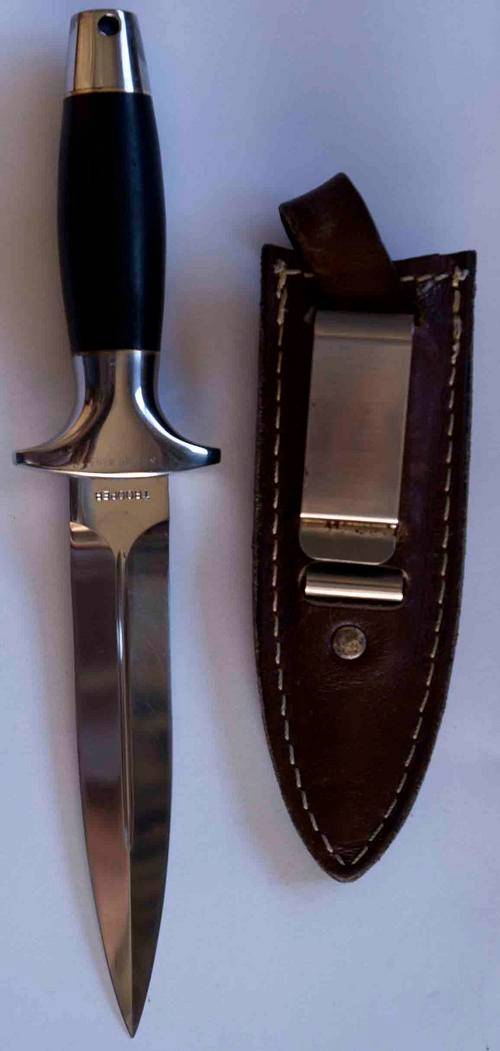
Kershaw Trooper No Serial Number
Kershaw Trooper No Serial Number Rating: 3,5/5 6650votes
The most complete up to date information and price guide on this unique dagger available anywhere! Now with several hundred serial numbers, production dates and market values covering all the years of production! Actual market values have been added to the bigger Kershaw Trooper Report. The larger report includes.
Knife Knotes 10 knife knotes part X Updated 1/2/04 'It does not take a majority to prevail. But rather an irate, tireless minority, keen on setting brushfires of freedom in the minds of men.' --Samuel Adams Red Cross Supply’s Multi-tools to Troops A recent article pointed out to us by our good friend Bernard Levine places the newest Red Cross Knives in the hands of troops. As many of you are aware the Red Cross knives of World War One are highly sought out collectors items of today.
This newest offering brings the idea up to date. Instead of the folding knife with spoon idea of long ago today the Red Cross is adding a multi-tool to the parcels.
While we have not yet seen a model of the item or who makes it the Red Cross has at least 10,000 planned for distribution. This is all paid for from donations to that organization. Also included in the parcels are a deck of cards, a book of crossword puzzles, snacks, games, suntan lotion, tissues, a hacky sack ball, moist towelettes, a hand-held fan and a multipurpose tool packaged in a lightweight, durable, reusable travel bag. Each bag also has an acknowledgement card that the gift is made possible through the generosity of the American people.
The cost for each package is $20 which makes us think the item may not be of the highest quality but one never knows what buying power they have at the 10,000 level. Either way a new collectible is now being sent to the folks in the field. If anyone has further information please let us know.
Camillus Desert Tan Knives A recent offering from Camillus Cutlery are the tried and true military knives coated in a Desert Tan epoxy coating. Using the USMC Fighting / Utility knife, the Jet Pilot Survival knife and the MIL-K-818C as the base these knives are then coated in the tan color. The fixed blades have the blades, guards and pommels coated while the folder only coats the handles. Not official military purchased knives they are really cool variations to those collecting such. We picked up all three for our collection and an extra or two for trades at some future date. Cost is low and the knives are being phased out now so maybe we will see prices rise in the aftermarket on these products in a few years, if not they are still neat items. Dented Scabbards In a recent article written for Knife World on the Model of 1910 bolo knife we stated that almost every metal scabbard we have seen is dented at the tip.
We have no idea but speculated it was due to packaging. Well we just received a letter from Mr. Hank Loescher which may clear up that speculation. In his letter to us Mr. Loescher states that many years ago he purchased a few cases of the metal scabbards still packed in the original shipping crates. Upon opening them they were found to be individually wrapped in brown kraft paper. The boxes were addressed to the Bush Terminal, Brooklyn, NY.
It seems they were sitting on the docks when the war ended so they never made it overseas. Each crate held 100 scabbards packed end to end, layered one row on top of each other. The rows were reversed upon each tier. This placed the hanger end right over the lower tip of the opposing scabbard and left a perfect dent in the bottom of each scabbard in the box.
None of these scabbards had ever seen usage yet each had a perfect dent in the back side of the bottom. Well, that does seem to clear up that little mystery to our satisfaction. Thanks for the letter Mr. Loescher, every little piece of the puzzle helps in assembling the whole picture! Marbles 5 inch Ideals in Military Usage We are trying to gather any information on the 5' Marbles Ideal pattern knife for a future article. The main gist of the article will be the use of the knives by the Army Air Force as a part of the Emergency Sustenance Kits issued to each aircrewman during the war.
We have some information on them but lack any connection with Marbles actually having a military contract. So far we have not found any evidence that they were purchased by the government. We all assume that the Bakelite pommel models were wartime issue but can we prove it not yet.
We do know that Marbles started using the plastic pommels during 1942 / 1943 but they also continued to sell them right up through the 1950’s so that in itself does not make it a military issue piece. Perhaps they could not obtain the aluminum pommels during the war and converted to the plastic but only for the private sales they still held. We also know that Camillus, Case and Kinfolks made the same pattern knife and sold them to the government for the AAF so why not Marbles? Either way it is an interesting subject that we wish to know more about. If you have any proof on the subject, such as a written document, not an oral history, we would be mighty glad to hear from you!
Queen City Stamps Here is a photo copy of a stamped turned up in the Queen factory. Notice anything unusual about it? We do not know if it was ever used but we doubt it. Any machete collectors out there have one so marked? We would love to hear about it if you do. Life-Raft Knives A recent solicitation for knife purchase by the government caught our eye. It was listed as a 'Knife, Combat with Lanyard', something we had not seen before.
The Mark 2 is listed as a 'Knife, Combat with Sheath' so we were thinking it would be around that line of knife. Further investigation proves it to be a Life-Raft knife. Looking up the NSN on the item (1095-01-350-1525), shows many have been purchased over the past year by the Aerospace Weapons Group out of the Defense Supply Center, Columbus. Well we are at a loss at to what one looks like. We do know of many life raft knives in the past but this one is a newer issue piece that sells for $33.90 each. Over one thousand purchased recently and the latest proposal list a one year open ended contract which could prove to be very large but not exceed $100,000.00. Again we are looking for help on this one, What does a Mark 3 Life-Raft knife look like??
Camillus Riser Cutters In a recent exchange with our good friend Tom Williams, Company Historian, Camillus Cutlery Co. We found out that Camillus made fixed blade riser cutters in 1966 and 1967. Not a lot of them mind you but they did make them. We see unmarked versions from time to time, we have seen the Schrade Walden marked models along with the Aerial Machine and Tool models but never a Camillus marked version. A New History Of The Double Bass Paul Brun Pdf Writer.
The marking were 62D4267 / 1966 on the base of the cutter like all the others. Most we have seen with this marking were ink stamped not actually hot stamped into the blade. That in itself is a fairly common marking but the real test in finding one is the thong eyelet. It is a brass eyelet but cadmium plated. This we have not observed but in reality we were not looking for it either. We have collected riser cutters for many years and have accumulated quite a few but none have this curious detail.
In total 12,000 were made and shipped to Bristol Dynamics, a subsidiary of British Aerospace. Now it could be they were made for the Commonwealth government or simply those were the folks we were purchasing parachutes or other kits from, no speculation on that part yet as further investigation continues. UDT Scabbard We find out from our good friend Bill Adams that the so called UDT scabbard shown in Cole IV pg. 81 was a commercially available scabbard sold by Healthways a well known divers supply company.
When Bill was trying to track them down as to who made them he ran into a stone walling from the Navy. Archer 15 1263 Manual Dexterity. Bill approached his then Senator Sam Nunn, head of the Senate Armed Services Committee to encourage the Navy to supply the name of the contractor. Well it worked, Bill was supplied the name of Healthways as the supplier. This it would seem leads to the fact that someone in the Navy knew of the scabbards. Bill tried to arrange for the procurement of them to sell through his company but the cost for the wholesale order was prohibitive to make any money with.
The scabbards were made in a Velcro closure as well and the familiar snap closure retaining strap. While we have never seen any proof that these scabbards were in fact used or tested by the SEALs we do now know they were commercially sold items and in fact the Navy knew about them. The A1 Folding Machete The Imperial folding machete often found in it’s original light colored leather holster is not of the World war two era.
We are constantly asked this question as they appear somewhat often in various auctions and at shows. Many are in quite nice condition, unused and excellent or better is common. These machetes were redesigned from the results of the 1944 machete test reports. The handles and the carrying method are but two items that jump right out to the casual observer. The obvious giveaway is the nomenclature printed on the scabbard, Machete with Scabbard / Type A-1 / NO. The last line is the drawing or engineering number beginning with the year.
This example is 1948 so that would make it a bit late for WW II. Although they are actually a 1947 design it was standardized with the drawing in 1948. The redesign is an answer to several criticisms of the 1942 pattern. One major fault being that the handle could fold up on one’s fingers, the formerly removable guard was redesigned to serve as a lock for the blade when it is open and to fold over the edge when it is closed. The guard-lock is permanently hinged at the end of the handle. Quite an amazing engineering feat and quite complex to envision at first until one is seen operate.
The soft leather sheath holds a sharpening stone in a pocket, in answer to another criticism of the original knife. The sheath was furnished only with a swiveling belt loop large enough for a waist belt of any sort but a rather awkward arrangement for someone wearing only a belt-less flight suit. What was the flyer to use in this case is unknown to us. When put to practical use it seems to be only a rather expensive piece of engineering compromised by committee. The handle is sharp for constant use and the weight and balance are completely off. The real V-44 as made by Case is a much better tool for use in the F1 Hot Weather kit that the A-1 was packed with and should have been included. In fact it would still be good inclusion in any of today’s kits.
Get a Kick Out of This Here we have a couple of photos from our good friend Bob Tronolone and his bike. Leave it up to a knife guy to come up with something like this! A great use for a Mk1918Mk1 handle on the loose. Bob’s working on a shifter now we can’t wait!
Updated 2/7/03 Quote: 'If we lived by the Golden Rule, there would be no need for other laws.' Ronald Reagan Quite a month This month we have two super contributions from Gary Cunningham and Bill Porter.
Gary starts a two part series on the First Production M4 bayonets while Bill opens up his vault to some on the rarest US bayonets ever producted. The only place you can find them is here, on US Military Knives. USMC Sword Star Marking Well it seems we kicked up a storm of controversy with this one. We received a load of e-mails on this topic yet haven’t reached the bottom of it, at least to our satisfaction. We still have not found an example in writing of the 'reason' it is placed there. We have several opinions that run from most likely to out right absurd.
As the official swords still have this marking on them, both officer and enlisted, there must be something in writing somewhere as to why it is so. Below are some of the responses we have received. Dear Frank, The 'star' symbol actually represents interlocking triangles which was a traditional symbol of armourers and swordsmiths. We used to use it in the 19th century, but it was copied widely so we changed to the 'sunburst' symbol we still use today. As far as I know there were no links to the Star of David.
Regards Rob Hadley Wilkinson Sword's Business Manager Dear Frank, In alchemy, the interlocking triangles represent Fire and Water together. A more practical theory is that during the Bar Kochba rebellion (first century), a new technology was developed for shields using the inherent stability of the triangle. Behind the shield were two interlocking triangles, forming a hexagonal pattern of support points. This became known as a symbol of strength. David Fuller Dear Frank, I found this on the Wilkinson Sword home page, perhaps it is the answer to you quest. Thank you for providing a thoroughly enjoyable web page. 'The interlocking triangles sometimes seen on older blades made by Wilkinson Sword is a mark originally used by Henry Wilkinson.
This mark represents the interlocking triangles of the armourer - an ancient symbol. It was used extensively by Wilkinson Sword in the 19th Century and was widely copied by other manufacturers and as a result has fallen out of use. As far as we are aware there is no association with the Star of David. It has since been replaced by the mark shown opposite, proclaiming the authenticity of each Wilkinson Sword.' Rich Gathier Dear Frank, Long before this hexagram became the emblem of Judaism, it was revered as the symbol of the joining of opposites - spirit and matter, yin to yang, heaven to earth, Shiva and Kali - that maintains life in the cycles of creation and destruction. The Seal of Solomon is a seal of protection and contains the invisible Seventh Seal made from the four elements plus the divine number 3. This symbol also was used in alchemy to symbolize alcohol - (fire and water), a union of water and heat in perfect harmony.
This possibly derived from the Hindu union of male-fire-lightning with female-water-ocean in the heart chakra (Anahola). In fact, the connection to the male-female union carries over also in the 'Sri Yantra' symbol of many triangles intersecting heaven and earth. GREEK: (Pythagorean system) Aphrodite (Goddess of Love) - the union of 2 and 3 METAPHYSICS: The symbol of the Order of the Golden Dawn William Shernoff Dear Frank, The hexagram of Solomon is an ancient symbol sometimes called the 'Star of David'. It is a protective talisman made to ward off negative or evil influences and to aid in attaining perfection in deeds. Anne Reid Dear Frank, Following WW I the sword was redesigned by Quartermaster General C.
McCawley USMC. This is when the current etch was added. In 2002 I had some correspondence with Mr. Phil Melling of Wilkinson-Sword, He informed me that the mark was not a Star of David but the Armourers Triangles.
Also that if you look at the mark inside of it is a circle with a smaller star and the word PROVED. This is all I have on it. Ron Braehler Dear Frank, The star was mentioned and condemned by the God of Israel in Amos 5:26 and it was called by Him, `the star of your god, Moloch' or otherwise called `Chiun'. Reference to Amos 5:26 and the Israelites having it in the wilderness was also made in Acts 7:43.
Here it was called the Star of Remphan. All these names refer to the `god' Saturn. The foregoing verifies that it was therefore in existence long before the time of Solomon. He took this symbol upon himself when he went into idolatry, and it became known as the `Seal of Solomon' in Arabic magic and witchcraft. Richard Adams Dear Frank, Found this on the below listed site: What is the significance of the star on the upper blade of the officer's and non-commissoned officer's swords? According to historian Ken Smith-Christmas, a curator at the Marine Corps Air-Ground Museum, Quantico,Va., the six-pointed star on the swords was originally a guild proof called the 'Star of Damascus,' an Eastern mark of distinction found on swords of high-quality workmanship. Over the years, the marking disappeared on blades.
Museum correspondence with sword makers such as Wilkinson and N. Meyers indicates manufacturers, primarily British, have reintroduced that marking on swords. Not the final answer but a start. Rich Van Damme Major, USMC (Ret ) So as you can see we have quite a few options to deal with here.
We thought we knew most of the visitors to the web site but this one really shocked us. It seems it came up on a hit from Yahoo.com and Google.com about the Star of David written into the page.
Surfers who have never been here before and actually have no interest in knives, bayonets or swords jumped right into the quest to find a reason or at least point the way to other opinions. We even received a few from the anti-semite crowd that we will not go into here, suffice to say they were rather vulgar. A huge thanks to all those who offered opinions and links to other pages.
We still haven’t run this one to ground but we are on the right track. It just may prove to be that a sword used for the pattern had this marking on it and ever since it has been included, there may not be a reason for it. Just one of the 'we always did it that way' answers, not quite to our liking but it is still an answer. Camillus Commemorative Knives A couple of 2-1984 dated Jet Pilot knives were recently found and our good friend Tom Williams was contacted to sort it out.
The knives were of the slab side design and etched with various scenes, one a B-52, one a Huey UH-1D among others. Tom responded that the knives were made for a company called Westwind productions. The knife was our model #5733 Pilot Survival knife with a polished blade and Parkerized guard and butt. The blade etching was done by Adrian Harris and if my memory is correct there were seven models of Viet Nam era aircraft.
As always, Thanks Tom! Quote The cavalryman wants a good horse, a good rifle, a good revolving pistol, and a knife. I adhere to the opinion stated in my letter of January 30, 1878 and recommend that the saber be abolished. Chief of Ordnance, Brig.
Benet Letter to Board on Army Equipments Convened December 16, 1878 Awards Department Below is a request for proposal issued by the U.S. Navy for incentive items to be given away as awards. We clipped out all the non-knife related items they were looking for.
Would this make them official US military knives? Department of the Navy, Naval Supply Systems Command, FISC PUGET SOUND, 467 W STREET, BREMERTON, WA, SOL # N00406-04-T-0039 The Fleet and Industrial Supply Center, Puget Sound, requires various brand name or equal trophy-like items for the Puget Sound Naval Shipyard Employee Performance Incentive Awards Program. 300 ea Buck 110 knife 350 ea Leatherman stainless steel 12 tools in one tool 200 ea Victorinox Swiss Army knives 125 ea small stainless steel buck knife If You Ever Wanted a Kukri Now is the time to buy one if you are looking for an official Gurkha military issue Kukri from Nepal. The deal finally went down, it was years in the making. The Kingdom of Nepal sold off all the arms from the ancient armory known as the Palace of Lagan Silekhana.
Many if not most of the weapons have never been touched in over 100 years. The Royal Nepalese Army has used British weapons since the end of hostilities with Great Britain in 1815. This weapons cache is a wonderful find to the collector of British weapons, including rifles, bayonets and swords. The edged weapons such as the Kukri are being sold by Atlanta Cutlery, right now. Don’t expect a museum piece, these were all issued and used weapons left in storage for many years. Of the examples we have seen there is a lot of gunk and storage marks.
Still with all that these are the times to buy Kukris if you ever wanted one. They have several models to choose from and coverage of different eras. IMA, is the company with the rifles and other weapons. Many bayonets were uncovered and are available from them.
A great time to buy British weapons. Many Kukris were used in the CBI theatre by U.S.
Military forces during World War Two. A look over some photos of Merrill’s Marauders will show the knife in the belts of several US soldiers. Now here is a piece of information usually over looked with any write up on a Kukri, to two utility blades. What are they and what are they for you ask The Chak-mak (blunt tool ) is used as a flint tool in fire making and a sharpener for the blade.
Using the Chak-mak against the edge of the Kukri to and fro in long parallel motions does the traditional method of sharpening a Kukri. The other knife accompanying Chak-mak is the Karda that is used for skinning and all around utility purposes. It is a well thought out tool that was made into a weapon by reasons of necessity, a well-respected weapon we should add. Quote If the ax is dull, And one does not sharpen the edge, Then he must use more strength.
Ecc 10:10 We think that is the first ax quote we have ever used! More on the Riser Cutters The fixed blade, Cutter, Pocket goes back to 1960 from some examples we have seen stamped in ink. Both the green and the orange examples we have are stamped with the same Part Number, 60C6037, with the first two digits being the year of the drawing for that part. This example is 1960. The earliest models are date stamped and are all green, at least in our collection. The orange came in much later The latest date stamp we have is 1992 which is orange. All of these lace onto the parachute harness attached directly to the risers next to the jumpers hands for easy reach.
When we wrote the article on the MC-1 several years ago we called the hook blade cutter end a 'shroud' cutter as do most collectors. We were severely reprimanded in a letter from a 20 year veteran jumpmaster who told us 'shrouds cover dead bodies. Risers connect to canopies and these knives are meant to cut either, but the cutting is to be done by a living person, not a corpse covered by a shroud.' From that point on we do not use the collector term of shroud cutter. The MC-1 is still supplied to aircrews and is still purchased by the government with Camillus being the current supplier. Two very different knives, with the MC-1 being able to accomplish two demanding jobs while the riser cutter is only meant to be used once the parachute is deployed.
In fact it can not be handled unless the parachute is open, it is packed inside the chute package. The MC-1 was originally designed to be worn in a pocket on the inside of the thigh sewn into the flight suit. The hook blade was to be open and a lanyard is attached to the bail for easy extraction from the pocket. The switch blade, although having a 'cool' factor was designed for one purpose, to easily open in the cramped confines of a cockpit when almost no movement could be made. It is for an emergency when the pilot’s air floatation device misfires and inflates while still flying.
The hand is naturally on the stick, next to the inner thigh. He can then pull on the lanyard to extract the knife from the pocket and push the button and stick the inflated 'Mae West' to release the air and regain control of the aircraft. That is the only reason it is a switchblade. The scenario of hanging in a tree with one arm broken was not contemplated during the original trials for the knives. It is something that became urban legend over the years. Well anyway both types are still in production and may be found at many shows if you look keenly for them. Both are still pretty cheap when found, even in excellent condition.
We are working closely on a full-blown article on these for Knife World in the very near future. Will up date you when it happens. Clyde Cutlery We received this from our good friend Carter Rila. Carter is the king of machetes and working tools, the knowledge he has gained from years of research is amazing. Clyde Cutlery was sold in June of 1970 to the Shelby-Clyde Corporation, Shelby, Ohio. The fire occurred in July of 1970.
Production did resume after the fire. The work largely involved finishing orders already received and working with materials salvaged from the blaze. Later in the year assets were sold to the Shelby Corporation and operations moved to Shelby. Of course we all know of the Clyde machetes and kitchen knives, this is what became of the grand old company.
Quote When the Feddle Gummint wants money, it makes things up—the Maine, the Gulf of Tonkin, nerve gas, Mars, the universe. It always works. Fred Reed 1/04 ROSCO For a few years we have searched for the source of the k-bar like knives marked ROSCO on the ricasso. Well our good friend Bernard Levine turned up the answer. Bernard answered the question in his WHUT IZZIT column in the January 2002 issue of Knife World. We only write it up now as we just received a request for identification on a knife marked ROSCO. Seems other folks might also like to know.
Kessler of California has identified ROSCO. In the early 1950s, Mr. Kessler was a salesman for Winfield Arms Corporation, the 'West's Largest Mail-Order Gun House.' One of his customers, for military surplus rifles, ammunition, etc., was a small importer in Los Angeles called the George Rose Company.
Rose's trademark, on knives that he imported, was ROSCO. Like most of the small-time cutlery importers in that period, ROSCO was short-lived. The firm was active from 1950 to 1955.' Thanks Bernard!
A New F/S Knife Turns Up From our good friend John Fischer we received this note. It is pretty amazing after all these years when a new item turns up to the collecting world. I believe I have made a new discovery of a previously unknown British Army Inspector. He must have not been at it very long before he left, or retired, was transferred to other duties, or whatever, as I have never heard of, nor seen this stamp before. I'm very excited as I thought that there were only five (5) different proof marks on early 3rd Pattern F-S Stilettos that have the Wilkinson characteristics.small pommel nut with familiar clamp marks, thick drop forged/hand ground blade, etc.
/I B2 (or /I B.) /I 42 /I 21 /I I /I V Or really on any British Commando Knife, and Commonwealth Knife or Bayonet for that matter.not just 3rd Pattern F-S Knives. Anyway this is what always keeps military knife collecting interesting, and never boring. If anyone has seen this proof mark before, please let us know.
Oh.of course you can all see that the die used and stamping details match other known proof marks, and there is no doubt in my mind that it is completely authentic, besides it's really only of interest to advanced F-S Knife collectors anyway and I doubt the forgers out there would waste their time. Thanks John, well done! Click on the thumbnails for the full size photos Quote The early bird might get the worm but the second mouse gets the cheese!
Unknown Mike Silvey Sales List Mike just published his List # 2 with a lot of great knives for sale. Many are very rare to encounter on the open market so it should be a list any active buyer is on the receiving end of. Nice short write ups and photos of the knives. You can contact Mike at: or by phone at 530-644-4590 Good hunting. Knife Prices We recently received a listing of prices on a few military knives recorded many years ago by our good friend Garry Zalesky. Garry was keeping record of sale prices and prices on knives in his collection. He recently discovered some of the old information he had stored away and sent it to us for a good laugh.
Seems military knives have been a rather good investment over the years in most cases. Some were as expensive back then as they are now.
Offered for your consideration is a scarce vintage Kershaw Trooper boot/fighting/survival knife. In my opinion, the Trooper is one of the very finest knives Kershaw ever made and this is one of the finest examples you'll see. The early knives were handmade and of exceptional quality. The design is outstanding with crisp, sharp lines and an aggressive profile. In my opinion, you'll simply not see the Kershaw name presented in a finer, more refined manner.
Because these early knives were entirely handmade, there is some variation in appearance even though the specifications are always the same. I've owned many these earlier knives over the years and they are always just exceptional knives. The fit & finish are absolutely flawless and the quality of the Gabon Ebony is simply amazing.The Trooper was one of Kershaw's most successful models. The Trooper was also Kershaw's longest running consecutively serial numbered model until it was discontinued in 2009. Every example since its release in 1979 has been serial numbered. The serial numbers were well into the 30,000+ range when it was discontinued. This piece bears serial number 13702 and was made in December of 1984.
Of significance is that the design has changed only very slightly over the years. The first 2,500 examples were made without a blood groove with the rest of the production (after 1980) having a deep, narrow fuller down the center of each side. This example came with one of the earlier brown leather rounded tip sheath that has the quick release tab on the retainer strap. This knife was made in Seki City, Japan, home of some of the world's finest knifemakers. Seki has an 800+ year tradition of steel and blade making. Most of the knives for the larger U.S. Companies like Kershaw were made by smaller operations with highly skilled craftsman.
In fact, one of Japan's most renowned makers is Ichiro Hattori who got his start in his father's shop and then went on to make knives for Kershaw, Browning, Beretta, and many other before opening his own custom shop. I'm not sure if Hattori made these knives or not. Hattori began making knives at age 18 in his father's shop and by 1971 had opened his own shop. Hattori gained widespread acclaim making knives for Beretta, Kershaw, Browning, SOG, and other well known brands. In the early 1990's he started his own line and was quickly recognized as making the finest hunting knives in Japan. That's really saying something when you're in Seki City, which is home to some of the finest craftsman in the world.
Hattori gained a reputation for seeking the ultimate in quality and a never compomise attitude. Hattori's knives are almost always sold out with very long waiting lists. In fact, it's impossible to even find out how long the wait is.
This is due to very limited production and long production times. Hattori's primary concern remains, as it has always been, the very highest quality. His knives are expensive, but the price and difficulty in locating quickly become secondary as soon as one of his knives is held. This is one of the knives that Hattori made. The knife has not been used, carried, or sharpened and remains about as close to perfect as you'll find. It has not been cleaned or buffed and remains original. It is also complete and includes everything that came with the knife: hardcase, engraving panel, certificate, and paperwork.
This example is really about as fine as they come. This is a heavy, solid knife with an outstanding feel. The super-thick blade was beautifully ground with perfect symmetry. The blade is double-edged and presents a menacing, aggressive profile. The blade has a needle-sharp tip and deep fullers down the center of the blade on either side.
Both edges are razor-sharp and will shave with the ease of a razor. The guard is of thick, heavy stainless steel with a brushed satin finish, while the front facing of the guard was more mirror polished. The handle is of Gabon Ebony and is exceptionally nice. While the handle appears to be nearly black, the Ebony actually has.