1240Ag Software Upgrade
1240Ag Software Upgrade Rating: 5,0/5 4941votes
Jun 18, 2009. Introduction How to update Access Point firmware using TFTP when it is not possible to perform update through the HTTP interface. Resolution Using the HTTP method to upgrade the firmware does not always work. In those cases, the best option is to. Canadian Forces Logistics Branch Handbook Of Chemistry there. 802.11a channels) with potentially up to 23 channels via a future firmware release depending on FCC rules. Other regulatory domains may support a different number of channels, simplifying deployments for high-capacity wireless networks. For investment protection, the Cisco Aironet 1240AG. Series fully supports the.
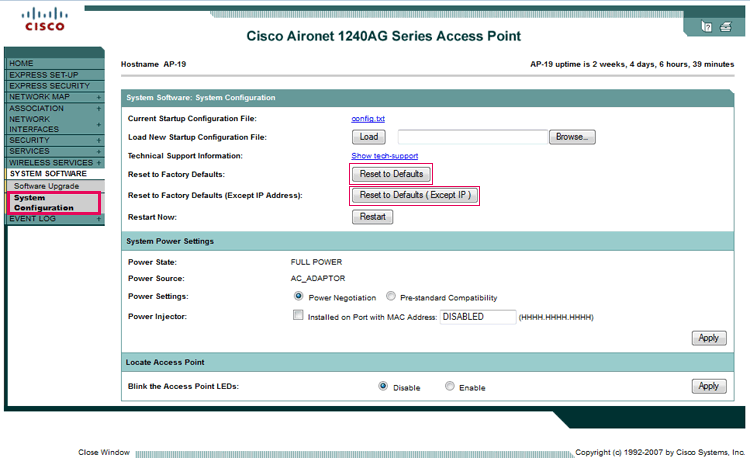
• • • • • • • • • • Introduction How to update Access Point firmware using TFTP when it is not possible to perform update through the HTTP interface. Resolution Using the HTTP method to upgrade the firmware does not always work. In those cases, the best option is to use the TFTP method which is telnet.
The TFTP method is more stable and can also help in circumstances where the Access Point (AP) firmware is to be overwritten due to shortage of Flash memory. To upgrade the firmware through TFTP, perform these steps: • Extract and install the TFTP server software. • Copy the downloaded image file for AP in the same directory where the TFTP is installed. To verify that the image is in the correct location, click on the Show Dir button, and verify that the image is listed along with other files. • On the Telnet session of the AP, type this command: AP# archive download-sw /force-reload /overwrite t address/image filename (for e.g c1200-k9w7-tar.123-4.JA.tar ) Preparing to Download or Upload a Configuration File by Using TFTP Before you begin downloading or uploading a configuration file by using TFTP, perform these tasks: • Ensure that the workstation acting as the TFTP server is properly configured. On a Sun workstation, make sure that the /etc/inetd.conf file contains this line: tftp dgram udp wait root /usr/etc/in.tftpd in.tftpd -p -s /tftpboot Make sure that the /etc/services file contains this line: tftp 69/udp Note You must restart the inetd daemon after modifying the /etc/inetd.conf and /etc/services files.
To restart the daemon, either stop the inetd process and restart it, or enter a fastboot command (on the SunOS 4.x) or a reboot command (on Solaris 2.x or SunOS 5.x). For more information on the TFTP daemon, refer to the documentation for your workstation. • Ensure that the access point has a route to the TFTP server. The access point and the TFTP server must be in the same subnetwork if you do not have a router to route traffic between subnets. Check connectivity to the TFTP server by using the ping command.
• Ensure that the configuration file to be downloaded is in the correct directory on the TFTP server (usually /tftpboot on a UNIX workstation). • For download operations, ensure that the permissions on the file are set correctly. The permission on the file should be world-read. • Before uploading the configuration file, you might need to create an empty file on the TFTP server. To create an empty file, enter the touch filename command, where filename is the name of the file you will use when uploading it to the server. • During upload operations, if you are overwriting an existing file (including an empty file, if you had to create one) on the server, ensure that the permissions on the file are set correctly.
Permissions on the file should be world-write. Fender American Deluxe Stratocaster Plus Hss Review. Downloading the Configuration File by Using TFTP To configure the access point by using a configuration file downloaded from a TFTP server, follow these steps: Step 1 Copy the configuration file to the appropriate TFTP directory on the workstation.
Step 2 Verify that the TFTP server is properly configured by referring to the 'Preparing to Download or Upload a Configuration File by Using TFTP' section. Step 3 Log into the access point through a Telnet session.
Step 4 Download the configuration file from the TFTP server to configure the access point. Specify the IP address or host name of the TFTP server and the name of the file to download. Use one of these privileged EXEC commands: • copy tftp:[[[//location]/directory]/filename] system:running-config • copy tftp:[[[//location]/directory]/filename] nvram:startup-config The configuration file downloads, and the commands are executed as the file is parsed line-by-line. This example shows how to configure the software from the file tokyo-confg at IP address 172.16.2.155: ap# copy t system:running-config Configure using tokyo-confg from 172.16.2.155? [confirm] y Booting tokyo-confg from 172.16.2.155:!!! [OK - 874/16000 bytes] Uploading the Configuration File by Using TFTP Uploading the Configuration File by Using TFTP To upload a configuration file from an access point to a TFTP server for storage, follow these steps: Step 1 Verify that the TFTP server is properly configured by referring to the 'Preparing to Download or Upload a Configuration File by Using TFTP' section. Step 2 Log into the access point through a Telnet session.
Step 3 Upload the access point configuration to the TFTP server. Specify the IP address or host name of the TFTP server and the destination filename. Use one of these privileged EXEC commands: • copy system:running-config tftp:[[[//location]/directory]/filename] • copy nvram:startup-config tftp:[[[//location]/directory]/filename] The file is uploaded to the TFTP server. This example shows how to upload a configuration file from an access point to a TFTP server: ap# copy system:running-config t Write file tokyo-confg on host 172.16.2.155?
[confirm] y # Writing tokyo-confg!!! [OK] Problem Type Upgrade Download Products Access point Bridge Product OS IOS Device Access Method GUI Interface Reference Link TFTP upgrade Free TFTP server.
Versatile, Secure Wireless Cisco Aironet 1240AG Series IEEE 802.11a/b/g access points deliver the versatility, high capacity, security, and enterprise-class features demanded by WLAN customers. Designed specifically for challenging RF environments such as factories, warehouses, and large retail establishments, they have the versatility associated with connected antennas, rugged metal enclosure, and broad operating temperature range. The Cisco Aironet 1240AG Series may also be configured to support, providing wireless connectivity for indoor areas that are difficult or impossible to wire. Mesh access points do not require wired connections; they use the 2.4-GHz frequency to deliver network access to users in hard-to-reach areas and the 5-GHz band to backhaul traffic to traditional access points connected to Ethernet ports.
The Aironet 1240AG Series is available in: • A lightweight version • An autonomous version that can be field-upgraded to lightweight operation • A single-band 802.11g version for use in regulatory domains that do not allow 802.11a/5 GHz operation The product comes complete with all the mounting hardware necessary for a secure, rugged installation. The mounting bracket locks the access point as well as the Ethernet and console cables in place to prevent theft and tampering. Featured Content Cut Costs with Teleworking OfficeExtend offers highly secure, cost-effective wireless. Extend connectivity for hard-to-wire environments.
Learn More Transform Your Business with Mobility Solutions Put your business in motion with high-performance wireless.. Product Support Services Cisco's Services can help you increase operational efficiency, lower support costs, and improve availability risk management. • • • Related Content.
